
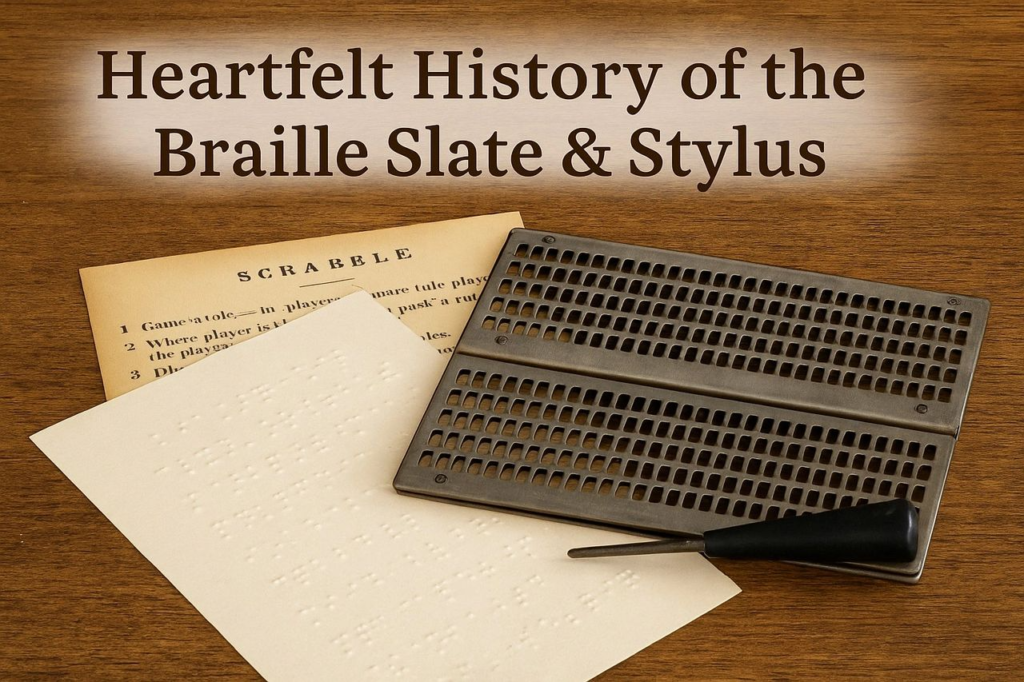
In a quiet world where whispering lines become words under fingertips, a humble tool has bridged generations: the Braille slate and stylus. Today’s featured piece—an elegant 1950s Braille slate with rare embossed documents—offers a window into an era of tactile literacy, resilience, and gentle ingenuity. 📝
🌟 The Origins: From Night Letters to a Universal Code
Long before Braille, there was a system used by French soldiers known as “night writing.” In the early 1820s, Charles Barbier devised a tactile code consisting of twelve-dot cells. It was meant to aid silent communication in battle—but too bulky for efficient reading.
Enter Louis Braille. Blinded by an accident at age three, young Braille became a student at the Royal Institute for Blind Youth in Paris. Inspired by Barbier’s concept, he refined a simpler, six-dot cell system in 1824 and published his innovative code by 1829. His system enabled both reading and writing—a profound leap forward.
🛠️ The Slate & Stylus: Simplicity in Design, Genius in Execution
The braille slate and stylus—a hinged metal or wooden frame with windows for six-dot cells—was the portable companion to this revolution. A person would place paper beneath the slate’s windows, and press the stylus through the holes, leaving raised dots on the reverse. Writing backwards was part of the magic: when flipped, the dots read correctly.
Mass-produced in the 19th–20th centuries, these slates gave independence to individuals—whether jotting a quick note, labeling items, or recording thoughts without assistance. As one user recalled, “children and adults…did not find using a slate any more challenging than using a pen and paper.”
📚 From 1950s Slate to Braillewriter Machine
While the slate remained essential, the late 19th and early 20th centuries welcomed mechanical Braillewriters—like Oscar Picht’s models in 1899 and Frank Hall’s 1892 invention. These predated the famous Perkins Brailler introduced in 1951, a sturdy, typewriter-style device still in use today thanks to its innovative design.
Yet even as electric embossers appear on desks, many blind individuals and educators still value the slate’s portability and low-tech elegance—especially in developing countries.
🧷 Why This 1950s Slate Is Special
Our listing offers a rare glimpse into tactile writing tools post-World War II. Vintage yet functional, with deep historical resonance:
Hinged metal slate and stylus
Accompaniments: embossed documents and instructional materials
Links you directly to mid-century Braille education culture
Ideal for collectors, educators, or those inspired by adaptive design
🛒 Explore & Own a Piece of Tactile History
🔗 View the full listing on Etsy
And if curiosity strikes deeper, uncover more about the evolution of Braille in our latest blog post:
📖 Read more: Heartfelt History of the Braille Slate & Stylus →
🌾 A Last Whisper
In a world where technology grows louder, this Braille slate whispers of simplicity, independence, and quiet ingenuity. May it inspire you to listen differently—and remember that small tools can hold great power.
✨ With depth and discovery,
—Tonya 🧡